

Final Report
Prepared for Shared Service Canada
Supplier Name: Phoenix SPI
Contract Number: 2B0KB-225917/001/CY
Award Date: 2022-01-24
Contract Value: $49,966.41 (including applicable tax)
Delivery Date: 2022-03-31
Registration Number: POR 110-21
For more information, please contact: INSERT SSC's EMAIL ADDRESS
Ce rapport est aussi disponible en français.
Shared Services Canada's "Employer of Choice" Strategy
Final Report
Prepared for Shared Services Canada
Supplier name: Phoenix Strategic Perspectives Inc.
March 2022
This public opinion research report presents the results of a set of eight online focus groups conducted with post-secondary students. The focus groups took place between March 15 and 23, 2022.
This publication may be reproduced for non-commercial purposes only. Prior written permission must be obtained from Shared Services Canada. For more information on this report, please contact: INSERT CONTACT INFORMATION FOR SSC.
Catalogue Number:
International Standard Book Number (ISBN):
Related publications (POR registration number: POR 112-21):
Catalogue number (Final report, French)
Aussi offert en français sous le titre : Stratégie « Employeur de choix » de Services partagés Canada.
Shared Services Canada (SSC) commissioned Phoenix Strategic Perspectives (Phoenix SPI) to conduct qualitative public opinion research (POR) to assess the effectiveness of creative concepts in promoting SSC as a career choice for information technology (IT) students and members of underrepresented groups.
The purpose of this qualitative research was to assess the effectiveness of creative concepts, imagery, taglines, messages, and products in promoting SSC as a career choice for IT students and members of underrepresented groups. The objectives of this research were to gauge participants' reaction to recruitment products and messages and to assess the attractiveness and persuasiveness of the materials and messaging in presenting SSC as a viable career choice. The products tested included creative concepts and taglines, social media content, SSC's career home page, a document with messaging to be used for recruitment purposes, and a short video about SSC.
Eight virtual focus group sessions were conducted between March 15 and 23, 2022 with post-secondary students studying at Canadian institutions in the following types of programs: 1) computer science, computer engineering, software engineering, mathematics and/or statistics (the primary audience); and public or business administration, public policy, or finance (the secondary audience). Five groups were conducted with members of the primary audience, two groups with members of the secondary audience, and one group with a mix of participants from both audiences. Three groups were conducted in French and five groups were conducted in English. Participants were paid an honorarium of $125.
This research was qualitative. Qualitative research is designed to reveal a rich range of opinions and interpretations rather than to measure what percentage of the target population holds a given opinion. As such, the results indicate post-secondary students' views about the issues explored, but they cannot be generalized to the full population of students studying in the targeted fields. With the foregoing in mind, the results of this research will be used by SSC to refine its "Employer of Choice" recruitment materials designed to help attract the knowledge workers necessary to continue developing and maintaining digital technologies supporting modern services that Canadians increasingly expect and demand.
Most participants said they have considered a career in the public service and pointed to the following reasons to explain why: job security, salary, work conditions, and benefits. Reasons for not considering public service included career pursuits not aligned with government work (e.g., wanting to own a business), as well as perceptions that government work tends to be bureaucratic, boring, and hierarchical.
When asked what a strategy designed to recruit talent to government departments should focus on, participants pointed to the following: competitive compensation packages; the work environment, including flexible work arrangements, available technology and budgets for research; the nature of the work at the department (i.e., cutting-edge, challenging); and the availability of growth opportunities.
Preferred methods for seeking and receiving career-related information include word of mouth (friends, family, alumni), job fairs, institutional career planning centers, social media, as well as various job search websites.
Awareness of SSC is very low. In most groups, no one had heard of the agency, and in the others, no more than a few participants had heard of SSC. In addition, those who claimed to have heard of SSC knew nothing or virtually nothing about it, describing it as the IT sector for the federal government and as an agency involved in 'networking' and 'information sharing'. As a result, none of the participants had any well-formed, or well-grounded, impressions of SSC.
Positive feedback on recruitment materials (i.e., concepts and taglines, handout, video) was often based on the inclusion of information about SSC and what it offers in terms of career options, while neutral and critical feedback was often based on the absence of such information.
Reaction to the three creative concepts and their accompanying taglines typically ranged from indifferent/neutral to critical. Such reactions were routinely based on the perceived absence or vagueness of messaging as it pertains to what SSC does and what it offers by way of career opportunities. While the graphics were often described as 'attractive' or 'eye catching', and the taglines sometimes described as 'catchy' or 'attention-grabbing', the messaging was routinely characterized as too general or generic.
Comparatively speaking, concept C ('Not your average government job') emerged as the favourite in terms of being most effective at increasing awareness of SSC as an employer and motivating participants to visit SSC's website for more information. Reasons provided included the eye-catching nature of the graphics, curiosity about the tagline, and the targeting of a young audience. The focus on inclusiveness/diversity was also identified as a reason for preferring concept C, though some participants suggested there is too much of an emphasis on this in the social media versions of the ads.
While concept C was selected most often as the preferred concept when participants were asked which concept would do the best job raising awareness of SSC and encouraging them to visit the agency's website, it was not viewed as a particularly strong concept. That is, of the three concepts tested, concept C was viewed as better than the concepts A and B, but not necessarily as a strong option on its own.
Reaction to the two designs of the SSC website's career home page tended to be positive, though it was more likely to be moderately than strongly so. Those who were not positive were more likely to be neutral than critical, sometimes adding that the designs are typical of government websites. Participants routinely indicated that both versions looked well structured and organized and that it would be easy for them to find information of interest or relevance to them.
They were most likely to identify concept 1 as their preferred version, though only slightly more likely to do so, with some saying they had no preference because the two versions were not significantly different. Characteristics underlying participants' preference for concept 1 included the 'Students and graduates' link, the 'Tools' section, and the impression that the overall look was lighter and less text heavy.
Participants tended to react positively to the one-page document. Many described it as clear, easy to follow, visually appealing, and well organized in terms of layout. In terms of content, participants tended to like the information about what SSC does and offers (in-demand skills), and the appeals to potential recruits ('We're hiring!', 'Are you ready to power-up your career by joining SSC?', 'Be part of the Government of Canada's digital backbone and help deliver programs and services to Canadians', and the link to careers at SSC). Information about diversity, accessibility, and inclusiveness ('Our differences make us better'), on the other hand, elicited mixed reactions. While some reacted positively to this, some did not, suggesting that there was too much emphasis/stress on this.
Reaction to the video tended to be mixed. While participants generally liked the content because it provided information about what SSC does, they tended to react critically to the voiceovers (both English and French) which were routinely described as monotone. Positive reaction to content was more likely to be the case among members of the primary IT audience than members of the secondary non-IT audience.
As a result of seeing the materials presented to them, most members of the primary audience were not noticeably more likely to consider a career in the public service (nor were they less likely to). To the extent that they were more likely to consider this, it tended to be because of specific references to IT-related positions in the materials, as well as general curiosity about what SSC, an organization they did not know about before, has to offer in terms of career possibilities.
Among members of the secondary audience, the materials and messaging were not particularly effective in presenting SSC as a viable career choice/option for them for two reasons: the concepts and taglines tended to be too vague and general about the types of career options available at SSC, while the materials that did provide such information (i.e., the one-pager and the video) focused on careers in IT. That being said, some members of the secondary non-IT audience indicated that would consult the SSC website out of curiosity.
Most participants in this study said they have considered a career in the public service. Among those who have not, some said they simply have never thought about this, while others said they have not considered it because of their preconceptions about a career in government. Such preconceptions were rarely so ingrained as to categorically exclude any consideration of working for government. In short, participants were receptive to the idea of a career in the public service, and the right recruitment products and messages could encourage students, in particular IT students, to consider SSC as a career choice.
The current set of draft recruitment products and messages, however, were not particularly effective in presenting SSC as a viable career choice. This was not because they failed to depict work at SSC as attractive. To the contrary, based on the materials presented to them, participants easily identified advantages of a career with SSC. These included job security as well as good working conditions. Both were identified by participants as important factors when considering their careers, as well as reasons why they have considered a career in the public service. Rather, the materials tended to be ineffective because they did not convey the message that SSC offers opportunities in participants' chosen field. Put succinctly, the extent to which participants were not interested in SSC was routinely a reaction to the impression that SSC is not interested in them. This was especially the impression among members of the secondary (non-IT) audience, but also among some members of the primary (IT) audience.
To connect more effectively with students, the research findings suggest that recruitment materials need to communicate who SSC is and what SSC offers. Although concept C emerged as the favourite concept, comparatively-speaking, it was no more effective than the others in communicating these two key messages. Indeed, a commonly offered suggestion to improve each of the concepts was to describe who SSC is and what it offers. Providing information about SSC is all the more important because the agency has virtually no name recognition among research participants. With a focus on both these perceived deficiencies, either one of the three concepts could be effective in encouraging students to consider SSC as a career possibility.
Based on the research findings, additional considerations for finalizing the recruitment products and messages include the following:
The contract value was $49,966.41 (including applicable tax).
I hereby certify as a Senior Officer of Phoenix Strategic Perspectives that the deliverables fully comply with the Government of Canada political neutrality requirements outlined in the Communications Policy of the Government of Canada and Procedures for Planning and Contracting Public Opinion Research. Specifically, the deliverables do not contain any reference to electoral voting intentions, political party preferences, standings with the electorate, or ratings of the performance of a political party or its leader.
(original signed by)
Alethea Woods
President
Phoenix Strategic Perspectives Inc.
Phoenix Strategic Perspectives (Phoenix SPI) was commissioned by Shared Services Canada (SSC) to conduct qualitative public opinion research (POR) to assess the effectiveness of creative concepts in promoting SSC as a career choice for information technology (IT) students and members of underrepresented groups.
Using a government-wide approach, SSC delivers reliable and secure IT operations, IT infrastructure and communication, as well as workplace technology services that support and enable government-wide programs and digital services for the Public Service. In order to deliver the services needed, SSC requires the ongoing recruitment of top-notch talent in a competitive IT labour market.
As a federal institution, SSC needs to identify such talent in a multitude of communities to help ensure its labour force reflects the diversity of Canada's population. As a result, to support recruitment, the Department has developed a promotion strategy that seeks to effectively connect with and attract upcoming IT talent to careers at SSC.
Public opinion research was conducted to assess the effectiveness of creative concepts, imagery, taglines, messages, and products in promoting SSC as a career choice for IT students and members of underrepresented groups. Specifically, the research was designed to determine the effectiveness of the products and messaging and (as needed) how to best modify the materials for maximum resonance with target audiences by:
The products tested included creative concepts and taglines, social media content, SSC's career home page, a document with messaging to be used for recruitment purposes, and a short video about SSC.
A qualitative research approach was used to meet the objectives. A set of eight online focus groups was conducted between March 15 and 23, 2022. Groups were segmented by region of the country to accommodate different time zones, with each group lasting up to two hours. There were two target audiences:
Participants were recruited through an online panel using a recruitment screening questionnaire. The short online questionnaire took no more than 5 minutes to complete. Groups included a mix of participants by gender and ageFootnote 1, type of post-secondary institution, program of study (within each of the two audiences), type of degree or diploma and anticipated year of graduation, as well as region of the country. In addition, groups included members of traditionally underrepresented groups, including Indigenous students, visible minorities, and students with disabilities.
Twelve participants were recruited for each group for seven to eight to attend each focus group session. In total, 58 students participated in the research; each group was attended by four to 10 students. Groups were conducted in the evening, and participants received an honorarium of $125 in appreciate of their time.
This section of the report focuses on career-related issues. Issues explored with participants included their career aspirations, influences on their career expectations and preferences, work experience in their field of study, preferred sources of information about potential career choices, and whether they have ever considered a career in the public service.
Participants aspire to various types of careers
Not surprisingly, participants identified various types of employment they are aspiring to after graduating from their field of study.Footnote 2 Among members of the primary audience, this included working in the following areas/sectors:
Among members of the secondary audience, this included working in finance/banking, human resources, public health, accounting, and public affairs/public policy.
Several participants, including a few members of the primary audience, stated explicitly at this point that they only want to work in one sector, i.e., only the public or only the private sector. Reasons for wanting to work in the public sector included job security, work-related conditions (e.g., leave provisions, employee rights) and compensation. Reasons for wanting to work in the private sector included wanting to own a business and wanting to be an entrepreneur.
Various things identified as attractive, appealing, interesting aspects of career choice
Participants had no difficulty identifying things that interest them about the career paths they have chosen. Routinely identified things mentioned by members of both audiences included the following:
Things mentioned less frequently, but in most groups, included the following:
Things identified by members of both audiences, but more likely to be mentioned or emphasized by members of the primary audience included the following:
Few perceived obstacles/barriers to finding the kind of employment they want
Most participants did not identify any obstacles or barriers that will make it difficult for them to find the kind of employment/career that they want. Perceived obstacles or barriers that were identified included the following, none of which was identified by more than a few participants:
None of the francophone participants identified language-related barriers or obstacles that will make it difficult for them to find the kind of employment/career that they want.
Various factors considered important when considering career/career options
Participants assigned importance to various factors when considering their careers and career options. Typically, they re-iterated or re-emphasized factors previously identified when discussing their career aspirations. Indeed, feedback in this area was virtually identical to feedback provided when discussing what interests them in, or attracts them to, their career choice. These factors included the following, with those more likely to be identified by members of the primary audience preceded by an asterisk (*).
Things sought for in an employer reflect things viewed as important in terms of one's career
Perhaps not surprisingly, things participants are looking for in a potential employer/workplace tended to echo things that are important to them in terms of their own careers. This included the following, with characteristics identified primarily or exclusively by members of the primary audience preceded by an asterisk (*):
A few participants said they wanted to work for a small or medium-sized firm or organization, associating the things they consider important with firms of this size, e.g., openness to ideas, collegiality/cooperation.
Specific individuals often mentioned as key career influencers
Asked who or what has shaped or influenced their career expectations and preferences and how, participants routinely identified specific individuals, almost always with a focus on how these individuals influenced career choice as opposed to career-related expectations.
The only influence beyond that of specific individuals was stereotypical assumptions about the possibilities of success and wealth in the IT sector, described as the dream of Silicon Valley.
Most have work experience in their field of study
Most participants, half or more in all but one group, said that they have experience working in their field of study. Things that participants liked about this experience included the following:
Only a small number of participants identified things they did not like about this experience. This included long workdays, not working with people of the same age, a toxic work environment resulting from poor management, and having to work exclusively online because of the pandemic.
As noted above, some participants said they enjoyed their work experience in their field of study because it helped to confirm their chosen field of study as something they want to pursue as a career. This same impression was echoed by many other participants when they were asked explicitly if the experience in any way shaped their career interests or expectations. Other ways in which the experience shaped career interests or expectations included reassurance/confirmation that they are studying in an area in which there are job opportunities, and increased marketability because of practical experience. No one identified any negative impacts on career interests or expectations resulting from their work experience in their field of study.
Most have considered a career in the public service
Most participants, half or more in every group, said that they have considered a career in the public service. Reasons for so doing routinely included job security, job stability, compensation, including salary and benefits, such as a pension, working conditions, such as hours of work and workspace layout, as well as work environment, which tended to refer to workplace culture. Reasons mentioned less frequently included the following:
Reasons for not considering a career in the public service included the following:
Variety of methods used to seek and receive information about potential career choices
Participants collectively identified a variety of preferred methods of seeking and receiving information about potential career choices. These included the following:
This brief section reports on participants' awareness and impressions of SSC.
Limited awareness of SSC
Awareness of SSC is very low/limited among members of both audiences. In five of the eight groups, no one had heard of the agency, and in the other three groups no more than a few participants had heard of SSC. In addition, those who said they have heard of SSC knew nothing or virtually nothing about it. It was described as the IT sector for the federal government and as an agency involved in 'networking' and 'information sharing'. As a result, none of the participants had any well-formed, or well-grounded, impressions of SSC.
Description of SSC elicits mixed responses
After being queried in an unprompted manner about their awareness and impressions of SSC, participants were provided the following brief description of the agency:
SSC is an agency of the Government of Canada responsible for digitally enabling government programs and services by providing IT services in the domains of networks and network security, data centers and Cloud offerings, and digital communications as well as providing IT tools that the public service needs to do its job.
On the basis of this description, participants were asked what they think SSC does—that is what kind of products and services it offers and to whom. Responses included impressions that SSC is a central agency that provides government-wide IT-related services (including their development, maintenance, and security), that it is responsible for the digitization of government programs and services, that it is responsible for managing government websites, and that it stores, protects, and manages the transmission of government data.
Asked if this sounds like the kind of work that might interest them, participants from the primary audience were much more likely to answer in the affirmative, mainly because the work sounded like it is in their area of study or related to their career interests, e.g., IT services and tools, cloud computing, data centers. Other reasons provided by members of the primary audience to explain their potential interest included the impression that SSC provides a vast array of work possibilities, that the work sounds important, and that it sounds like it is impactful/consequential, i.e., it allows the public service to do its job.
Members of the primary audience who said that this does not sound like the kind of work that would interest them explained that it seems unrelated to their field of study or their career interests (e.g., engineering, building things, robotics), and that they are not interested in working for government. For their part, participants from the secondary audience were much more likely to say that the work does not sound like it is related to their field of study or career interests, or to say that they are unsure and need more information about SSC.
This section reports on participants' reactions to, and impressions of, draft advertising materials designed to promote SSC as a career choice. Materials shown to participants included the following:
Participants were informed that these materials were not final.
Perceptions on where to focus to recruit talent to government departments/agencies
In advance of presenting the materials, members of the primary audience were asked what a promotion strategy should focus on to recruit talent in the IT sector to government departments or agencies. In response, participants studying in computer science and engineering identified the following:
General overview of findings
Reaction to the recruitment materials varied. Overall reaction to the creative concepts and taglines tended to range from neutral or indifferent to critical. Feedback on the designs of the career home page, the one-page document, and the video was mixed, but more likely to be positive than feedback on the creative concepts and taglines.
A key factor informing feedback on the recruitment materials was participants' lack of awareness of SSC and knowledge of what the agency does. As noted in the previous section, very few had heard of SSC prior to this research. As a result, and perhaps not surprisingly, feedback on materials was routinely influenced by the amount and/or type of information provided about SSC. Positive feedback was often based on the inclusion of information about SSC and what it offers in terms of career options, while neutral and critical feedback was often based on the absence of such information in the recruitment materials.
This sub-section reports on findings related to the creative concepts and taglines designed to promote SSC as a career choice. Participants were shown three versions of creative concepts with accompanying taglines, identified as follows for the purpose of presentation:
Participants were informed that the ads would appear on SSC's social media, specifically its Twitter account and LinkedIn page. When presenting each concept, participants were first shown the approach (i.e., concept and tagline), followed by versions showing what the approach might look like as a Twitter and LinkedIn post. The order of presentation of the concepts was rotated across the groups.
Overview
Overall, reaction to the three creative concepts and taglines tended to range from neutral or indifferent to critical. Such reactions tended to be based on the absence or vagueness of the message as it pertains to what SSC does and what it offers by way of career opportunities. While the graphics were often described as 'attractive' or 'eye catching', and the taglines sometimes described as 'catchy' or 'attention-grabbing', the messaging was routinely characterized as too general or generic. Participants felt that the messaging could apply to a number of organizations, from banks to telecommunications companies.
Social media versions of the concepts referencing what SSC offers by way of career opportunities tended to elicit more positive reactions, but the extent to which the ads were likely to be noticed was based as much on the appeal of the graphics as the allure of the messaging (i.e., feeling targeted by the ad). As a result, the social media treatments were relatively limited in their ability to encourage or motivate people to visit the SSC website and consider SSC as a viable career option.
To the extent that they were effective in this regard, it was much more likely to be among members of the primary audience because of references to positions in IT. To the extent that they were effective among members of the secondary audience, it was more likely to be the result of curiosity about SSC than any sense that the social media posts speak directly to them because of their career aspirations. Suggestions to make the social media posts more effective in this regard routinely included clarifying who SSC is and providing examples of the range of career possibilities.
Concept C ('Not your average government job') emerged as the favourite in terms of being most effective at increasing awareness of SSC as an employer and motivating participants to visit SSC's website for more information. Reasons provided included the eye-catching nature of the graphics, curiosity about the tagline, and the targeting of a young audience. The focus on inclusiveness and diversity was also identified as a reason for preferring concept C, though some participants suggested there is too much of an emphasis on this in the social media versions of the ads. While concept C was viewed as better than the concepts A and B, it was not necessarily viewed as a strong option on its own.
Overall impressions of concept
Overall reaction to this concept tended to be neutral/indifferent, based mainly on the impression that the approach is generic and that the images and tagline communicate nothing specific about SSC. Both could be used to promote any type of organization. By way of example, participants in various groups said that the concept reminds them of ads promoting a bank or financial institution. Adding to the perceived vagueness or indefiniteness of the concept was the absence of information about SSC. Participants' initial reaction to this concept was often to ask: 'what is SSC?' or to note the concept does not say anything about SSC or even provide the full name of the agency in the tagline. For some participants, the vagueness of the ad elicited curiosity about SSC rather than interest in it as a potential employer.
Specific things participants liked about the concept, or that drew their attention in a positive way, included the following:
When it came to things participants did not like, the emphasis was on the perceived vagueness of the approach, with a focus on the following:
Message(s) communicated by ad
While it was clear to participants that SSC is the sponsor of the ad, it was routinely noted that it is not clear who SSC is, or what it does. Despite that, participants did identify messages or elements of messaging in the concept. Although the tagline 'Invest in your career at SSC' was routinely described as generic, it was also seen as conveying the following messages:
Messages seen to be conveyed by the images included the idea that SSC is inclusive, that it offers flexible work arrangements, and that it is a pleasant place to work. Finally, for some, the combination of the tagline and images conveyed the message that SSC offers employment in the financial/banking sector.
Social media ads
The effectiveness of the social media versions of this concept in terms of motivating participants to visit the SSC website or make them think of SSC as a viable career choice/option, varied. The most commonly given reason to explain the limited effectiveness of the social media ads was the vagueness and/or generality of the ads, and lack of information about SSC and what if offers in terms of career options. Among participants from the secondary audience in particular, there was a widespread assumption that SSC does not offer jobs in their career area because of specific references to 'computer systems' and 'IT'. Those who said they would visit the website and/or think of SSC as a viable career choice/option were mainly members of the primary audience who typically indicated that it was because of specific references in the posts to 'IT' and 'computer systems'. Some members of the primary audience said they would be motivated to visit the website by the job-related link in these ads.
The emphasis on diversity (i.e., #Autism and learning/social disorders) in one of the social media posts had a mixed impact. Some said this would motivate them to visit the website or consider SSC as a career option. On the other hand, some said it would dissuade them (or at least not motivate them) because it sounds like SSC is targeting people with autism or who identify as having learning or social disorders. As a result, they do not feel addressed by the ad. The reference to 'five available positions' in the same ad had a similarly mixed impact: some said they were motivated to visit the website as a result of it, while others said they were dissuaded to do so because only five positions suggests limited opportunities.
Suggestions for improving concept
Suggestions for making this ad more effective included the following:


Overall impressions of concept
Overall impressions of this concept also tended to be neutral/indifferent, based primarily on the vagueness of the ad and lack of information about SSC. By way of example, a few participants' initial reaction to the tagline 'Your next move is here' was to ask: 'where is here?'. Initial reactions, however, often included positive impressions of the visual presentation in general and the use of icons in particular. Regarding the icons, it was routinely observed that they indicate or point to the kind of career opportunities available at SSC. In this regard, the concept was often compared favourably to concept A.
Specific things participants liked about the ad, or that drew their attention in a positive way, included the following:
Elements participants did not like or commented on critically included the following:
Message(s) communicated by ad
It was not evident to many participants that SSC is the sponsor of the ad because SSC is not identified in the tagline. That said, participants did detect messages or elements of messaging in the concept. While the tagline 'Your next move is here' was often described as vague or general, it was seen as conveying the following messages:
A message seen to be conveyed specifically by the icons was that SSC offers a range of opportunities in IT-related sectors, while a message seen to be conveyed by the tagline and the pictures was that SSC is looking to hire recent graduates. In the case of the tagline this was based on the impression that 'next move' means next move after graduating.
Social media ads
As was the case with concept A, the effectiveness of the social media versions of this ad in motivating participants to visit the SSC website or making them think of SSC as a viable career choice/option varied. The ads were most likely to be described as at least somewhat effective among members of the primary audience because of the focus on IT-related jobs in the text and through the icons.
On the other hand, some members of this audience described the ads as ineffective in this regard for the same reason, i.e., their career path does not lie in the IT sector. This impression was much more widespread among members of the secondary audience, i.e., the assumption that SSC does not offer jobs in their career area because of the emphasis given to IT-related work through the icons and the text/script in the media posts.
Over and above the focus on IT-related jobs in the text and through the icons, additional motivating factors included the following:
Regarding the latter, emphasis on diversity and inclusion did not dissuade anyone from visiting the website or considering SSC as a viable career choice, as was the case with concept A. That said, some participants thought that too much emphasis was placed on it, observing that diversity and equity policies are standard practice in government. In other words, there is nothing unique about SSC's commitment to them and consequently no need to over-emphasize them.
Suggestions for improving concept
Suggestions for making this concept more effective included the following:

Overall impressions of concept
Overall reaction this concept ranged from moderately positive to neutral/indifferent, to critical. In addition, feedback was sometimes mixed, in the sense that the same features elicited both positive and critical reactions. For example, positive impressions were based mainly on the tagline, and the visual aspects, but these also elicited critical comment. Initial reactions to this concept often focused on the tagline, which was often the first thing to attract participants' attention.
Specific things participants liked about the concept, or that drew their attention in a positive way, included the following:
Things that elicited critical reactions included the following:
Message(s) communicated by ad
As was the case with concept B, it was not clear to some participants that SSC is the sponsor of the ad because there is no prominent/visible reference to it. When it came to messaging, the focus was on the tagline 'Not your average government job'. This was routinely seen as suggesting that work at SSC is exciting, stimulating, varied, and unconventional (by way of comparison with other government jobs). A few suggested specifically that the message is designed to burst the traditional image of, or stereotypical assumption about, government work as routine.
Focusing on the latter point, a few participants suggested that precisely by alluding to this stereotype, the tagline brings it to mind, focusing attention on the idea that government work in general is unstimulating. In other words, there was a sense that the ad might actually reinforce a prejudice about government work by trying to combat it. Related to this, a few participants felt that the message conveyed in this ad was negative (i.e., conveying a negative impression other government jobs), or meaningless (i.e., making a general comparison to other government jobs instead of saying something specific about work at SSC).
Social media ads
The perceived effectiveness of the social media versions of this ad in motivating participants to visit the SSC website or making them think of SSC as a viable career choice/option varied by audience but also among members of the primary audience. Members of the primary audience aspiring to careers in IT related fields tended to describe it as at least somewhat effective in this regard, precisely because of the focus on this area.
However, other members of this audience described it as ineffective or not very effective for two reasons: one was the assumption that SSC does not offer jobs in their career area because of the focus on cloud computing technology. The other was lack of interest in working for government, despite the tagline's suggestion that SSC is not typical government work. For their part, members of the secondary audience tended to describe the ad as ineffective because SSC does not seem to offer careers in their area. Over and above the focus on IT-related jobs in the text, additional motivating factors among members of the primary audience included the following:
Suggestions for improving concept
Suggestions for making this ad more effective included the following:
Comparison of ads
Concept C emerged as the favourite in terms of being most effective at increasing awareness of SSC as an employer and motivating participants to visit SSC's website for more information. Reasons provided included the eye-catching nature of the graphics, curiosity about the tagline, the fact that the tagline challenges a stereotypical impression of government work, and the targeting of a young audience. The emphasis in the photo on inclusiveness/diversity was also identified as a reason for preferring concept C. While concept C was selected most often as the preferred concept, it was not viewed as a particularly strong option on its own.
This sub-section reports on findings related to designs of the SSC website's career home page. Participants were shown two different design options of the career home page, labelled concept 1 and concept 2. The order of presentation of the options was rotated across the groups.
Overview
Reaction to the two designs of the SSC website's career home page tended to be positive, though it was more likely to be moderately than strongly so. Those who were not positive were more likely to be neutral than critical, sometimes adding that the designs are typical of government websites. Participants routinely indicated that both versions looked well structured and organized and that it would be easy for them to find information of interest or relevance to them. They were most likely to identify version 1 as their preferred version, though only slightly more likely to do so, with some saying they had no preference because the two versions were not significantly different. Characteristics underlying participants' preference for version 1 included the 'Students and graduates' link, the 'Tools' section, and the impression that the overall look was lighter and less text heavy.
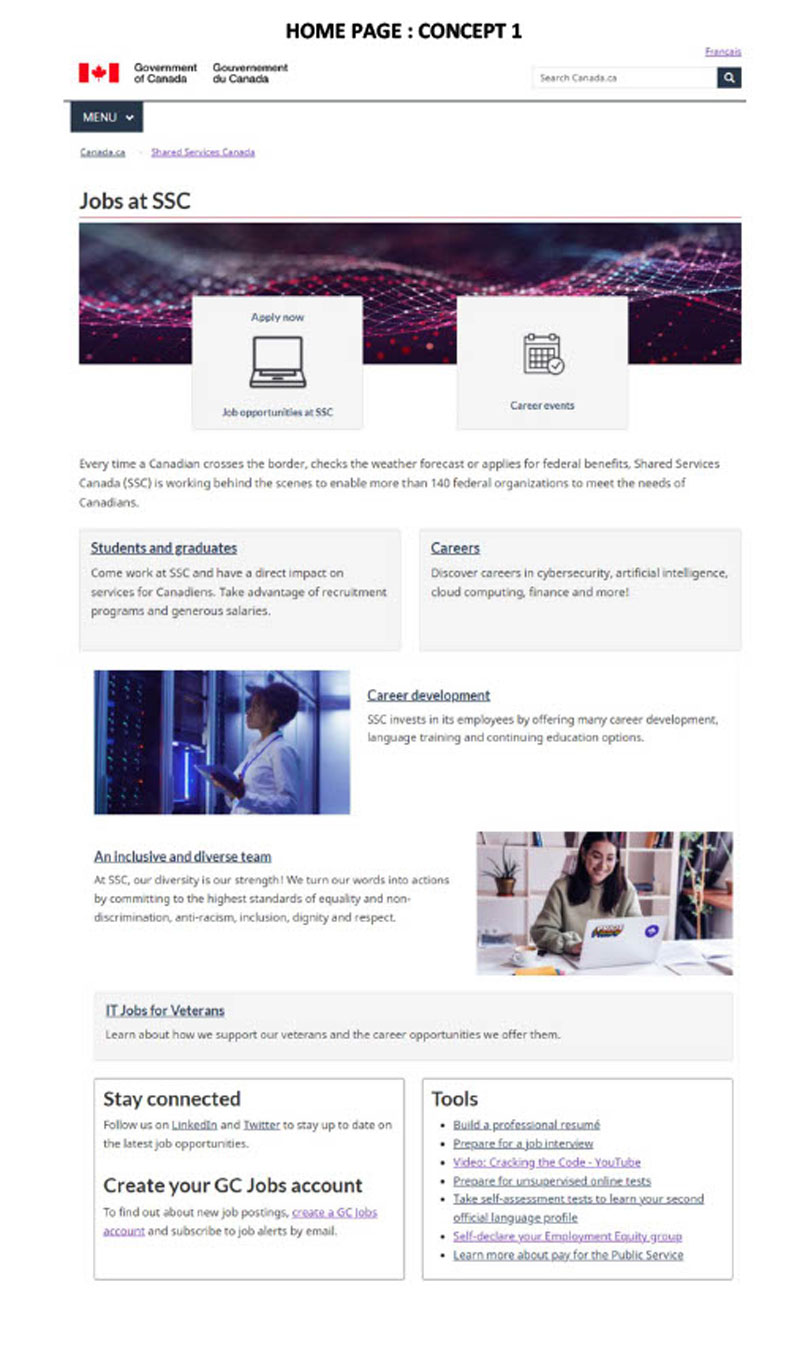
Overall impressions of web page design
Overall impressions of this career home page tended to be positive, and those who were not positive were indifferent or neutral rather than critical, sometimes describing it as a typical government site or what they would expect from a government site. Participants routinely described the overall look of the page as well organized or structured. Specific aspects of the site that participants liked or that elicited positive feedback included the following:
While nothing elicited strongly critical feedback, a few did not agree with the general impression about the use of space, suggesting that the page looked a little crowded or cramped.
Impressions regarding ease of use
In commenting on the design, no one suggested that they would have any difficulty finding information of interest or relevance to them, either because of the organization of the page or unclear language.
Suggestions for improving the design
Very few suggestions were made to improve the design. Those that were made included providing examples of jobs offered at SSC and information about salaries and benefits, aligning the pictures associated with 'Career development' and 'An inclusive and diverse team', removing the 'Stay connected section', adding a Facebook page to the 'Stay connected section' and changing 'Offres d'emplois' to 'Offres de carrières'. While it was not suggested that the 'IT jobs for veterans' link be removed, it was suggested that it was not relevant to students.
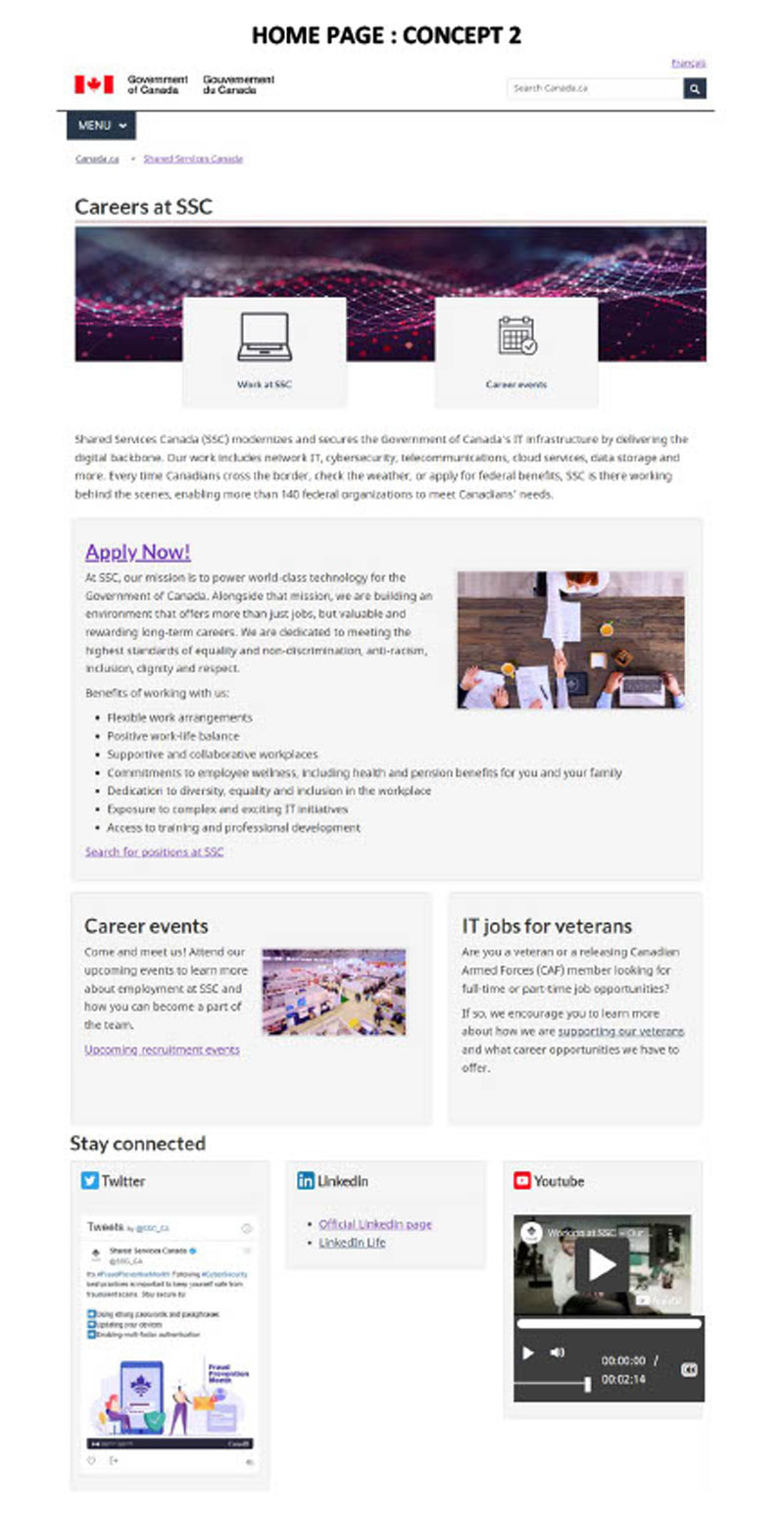
Overall impressions of web page design
As was the case with version 1, impressions of version 2 of the SSC career home page tended to be positive, with those who were not positive being indifferent or neutral rather than critical. Participants once again routinely described the overall look of the page as well organized or structured. Specific aspects of the site that participants liked or that elicited positive feedback included the following:
Once again, nothing elicited strongly critical feedback, and critical feedback that was provided focused on the following: the impression that there is too much text, particularly in the 'Apply now' section, the absence of 'Students and graduates' link and 'Tools' section, and the 'Apply now' label. Regarding the latter, it was suggested that the label should be changed because 'Apply now' gives the impression of hastiness, moving quickly, or following an order, when the emphasis should be more on inviting people to take time exploring what is available in terms of career possibilities at SSC.
Impressions regarding ease of use
As with version 1 of the career home page, no one suggested that they would have any difficulty finding information of interest or relevance to them because of the organization of the page or unclear language.
Suggestions for improving the design
Very few suggestions were made to improve the design. Those that were made included adding a 'Students and graduates' and 'Tools' link, cutting text in the 'Apply now' section, changing the name of the 'Apply now' section, and removing the social media links. Here as well it was suggested that the 'IT jobs for veterans' link would not be relevant to students.
Asked which of these two designs they prefer, participants were most likely to identify version 1 as their preferred version, though they were only slightly more likely to do so, with some saying they had no preference because the two versions were not significantly different. Characteristics underlying participants' preference for version 1 included the 'Students and graduates' link, the 'Tools' section, and the impression that the overall look was lighter and less text heavy. Some suggested a hybrid model, based on using the content of concept 1 and the style of concept 2. More specifically, they explained that they would like a version with the 'box-like' format of concept 2 that includes the 'Students and graduates' link and the 'Tools' section from concept 1.
This sub-section reports on findings related to the one-page document with information on recruitment at SSC.
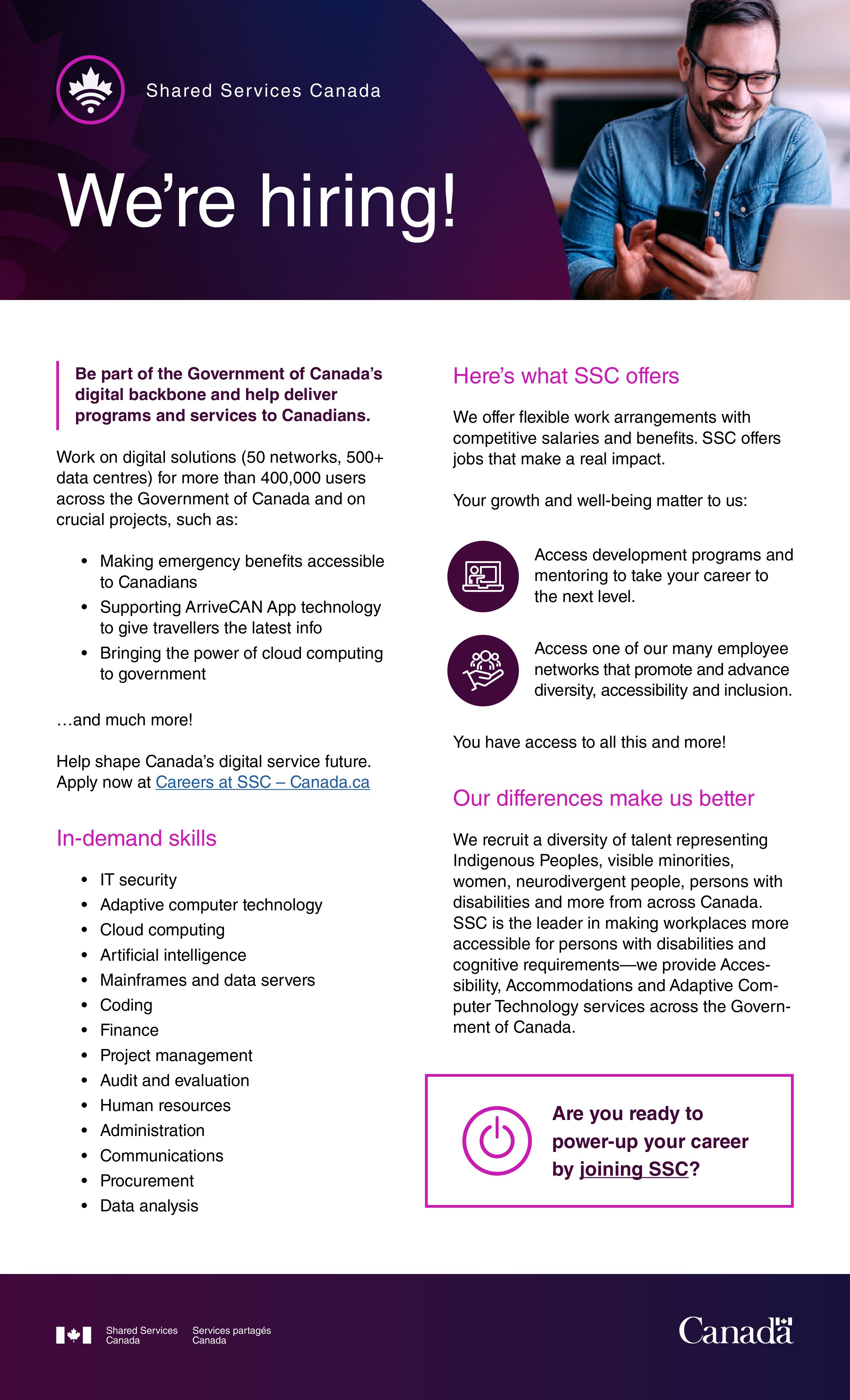
Participants from both audiences tended to react positively to the document with information on recruitment at SSC. Many described it as clear, easy to follow, visually appealing, and well organized in terms of layout. In terms of content, participants tended to react positively to information about what SSC does and offers (in-demand skills), and to appeals/reaching out to potential recruits ('We're hiring!', 'Are you ready to power-up your career by joining SSC?', 'Be part of the Government of Canada's digital backbone and help deliver programs and services to Canadians', and the link to careers at SSC). In commenting on information about what SSC does and offers, some participants suggested that this was the kind of information missing in the concepts.
Information about diversity, accessibility, and inclusiveness ('Our differences make us better') elicited mixed reactions. While some reacted positively to this, some did not, suggesting that there was too much emphasis/stress on this.
This sub-section reports on findings related to the short video about SSC.
Overall mixed impressions
Reaction to the short video tended to be mixed. Participants were most likely to react positively to the content, which was described as informative because it describes what SSC does. Positive reaction to content, however, was more likely to be the case among members of the primary audience than members of the secondary audience. While the latter liked the fact that the video provides information about SSC, it was routinely observed that the emphasis is on careers in IT, and since they are not interested in such a career, the video does not resonate with them. This point was also made by some members of the primary audience who did not feel targeted or addressed by what the video focuses on, including cloud computing and supporting communications satellites.
Over and above the content, a number of participants also liked the style of presentation, describing it as sharp, crisp, to the point, and making good use of colours and images. That said, one aspect of the presentation that was roundly criticized was the voiceover. This was the case across audiences and language groups. Specifically, the voiceovers were routinely described as monotone, boring, and robotic. The voiceover in the French version was also described as sounding like an anglophone speaking French. Other aspects of the video that were criticized, though infrequently, included the following:
Effectiveness of video in sustaining attention and drawing to SSC website
The perceived effectiveness of the video in attracting and sustaining participants' attention was based mainly on its content, i.e., the information about what SSC does and what it has to offer. Members of the primary audience with a career interest in IT-related sectors were most likely to describe the video as effective in this regard. Conversely, members of the secondary audience and members of the primary audience with career interests not focused specifically on IT tended to describe the video as ineffective in this regard. While many among the latter liked the fact that the video provides information about SSC, it was routinely observed that the emphasis is on careers in IT, and since they are not interested in a career in this field, the video does not really resonate with them.
In short, the key factor underlying the perceived effectiveness of the video in attracting and sustaining participants' attention was the extent to which it spoke to their career aspirations. Beyond this, the only thing adversely affecting the likelihood that participants would watch the video from start to finish, including ones who felt targeted by the message, was the voiceover.
The key factor underlying the extent to which the video would motivate participants to visit SCC's website for more information about a possible career with the department was also the extent to which it spoke to their career aspirations.
This section reports on participants' overall reactions to the materials presented to them.
Several perceived benefits or advantages of a career with SSC identified by participants
Based on the materials presented to them, participants identified the following as the main perceived advantages of a career with SSC.
Materials are not particularly effective in presenting SSC as a viable career choice/option
As a result of seeing the materials presented to them, most members of the primary audience were not noticeably more likely to consider a career in the public service (nor were they less likely to). To the extent that they were more likely to consider this, it tended to be because of specific emphasis on/references to IT-related positions in the materials, as well as general curiosity about what SSC, an organization they did not know about before, has to offer in terms of career possibilities.
Among members of the secondary audience, the materials and messaging were not particularly effective in presenting SSC as a viable career choice/option for them. The reason for this was twofold: the concepts and taglines tended to be too vague and too general about the types of career options available at SSC, while the materials that did provide such information (i.e., the one-pager and the video) focused on careers in IT. Some members of the secondary audience, however, did indicate that would consult the SSC website, but that they would do this out of curiosity rather than interest necessarily in exploring career opportunities.
Motivation/encouragement to consider a career with SSC
By way of conclusion, participants were asked what would motivate or encourage them to consider a career with SSC. Beyond some indication that SSC offers opportunities in their chosen field, participants identified the following:
Most participants in this study said they have considered a career in the public service. Among those who have not, some said they simply have never thought about this, while others said they have not considered it because of their preconceptions about a career in government. Such preconceptions were rarely so ingrained as to categorically exclude any consideration of working for government. In short, participants were receptive to the idea of a career in the public service, and the right recruitment products and messages could encourage students, in particular IT students, to consider SSC as a career choice.
The current set of draft recruitment products and messages, however, were not particularly effective in presenting SSC as a viable career choice. This was not because they failed to depict work at SSC as attractive. To the contrary, based on the materials presented to them, participants easily identified advantages of a career with SSC. These included job security as well as good working conditions. Both were identified by participants as important factors when considering their careers, as well as reasons why they have considered a career in the public service. Rather, the materials tended to be ineffective because they did not convey the message that SSC offers opportunities in participants' chosen field. Put succinctly, the extent to which participants were not interested in SSC was routinely a reaction to the impression that SSC is not interested in them. This was especially the impression among members of the secondary (non-IT) audience, but also among some members of the primary (IT) audience.
To connect more effectively with students, the research findings suggest that recruitment materials need to communicate who SSC is and what SSC offers. Although concept C emerged as the favourite concept, comparatively-speaking, it was no more effective than the others in communicating these two key messages. Indeed, a commonly offered suggestion to improve each of the concepts was to describe who SSC is and what it offers. Providing information about SSC is all the more important because the agency has virtually no name recognition among research participants. With a focus on both these perceived deficiencies, either one of the three concepts could be effective in encouraging students to consider SSC as a career possibility.
Based on the research findings, additional considerations for finalizing the recruitment products and messages include the following:
Thank you for your interest in this research study. This short online questionnaire will take no more than 5 minutes to complete. The purpose of the online questionnaire is to confirm the eligibility of individuals interested in participating in this research study.
For more information about this research, contact Phoenix SPI by email at research@phoenixspi.ca or by telephone at 1-844-960-1700.
Phoenix SPI
1678 Bank Street, Ste. 2
Ottawa, ON K1V 7Y6
www.phoenixspi.ca
1. Are you a Canadian citizen or permanent resident at least 18 years of age or older?
01. No THANK/TERMINATE
02. Yes CONTINUE
[TERMINATION MESSAGE - AGE: Thank you for your interest. To be eligible for this research study you must be 18 years of age or older and a Canadian citizen and permanent resident.]
2. In which of the following age categories do you belong? [RECRUIT A MIX]
01. 18 to 24
02. 25 to 29
03. 30 to 34
04. 35 to 39
05. 40 or older
3. Do you, or a member of your household or immediate family, work in any of the following fields?
a. Marketing research, public relations firm, or advertising agency
b. The media (i.e., radio, television, newspapers, magazines, etc.)
01. Yes THANK/TERMINATE
02. No CONTINUE
[TERMINATION MESSAGE – INDUSTRY: Thank you for your interest. Unfortunately, you are not eligible to participate in this study.]
4. Are you currently enrolled in a program of study at a Canadian post-secondary institution? [RECRUIT A MIX]
01. Yes, at a university CONTINUE
02. Yes, at a college, institute, cegep or polytechnic CONTINUE
03. No THANK/TERMINATE
[TERMINATION MESSAGE – PSE: Thank you for your interest. We are currently looking for participants who are enrolled in a program of study at a Canadian post-secondary institution.]
5. Are you currently enrolled in any of the following types of programs?
Select all that apply
01. Computer Science [COMPUTER SCIENCE]
02. Computer Engineering [COMPUTER SCIENCE]
03. Software Engineering [COMPUTER SCIENCE]
04. Information or Data Science [COMPUTER SCIENCE]
05. Network or Computing Communications [COMPUTER SCIENCE]
06. Information Technology (IT) Security [COMPUTER SCIENCE]
07. Cloud Computing [COMPUTER SCIENCE]
08. Mathematics (not including Economics) [COMPUTER SCIENCE]
09. Statistics (not including Economics) [COMPUTER SCIENCE]
10. Public Administration [BUSINESS/PUBLIC ADMIN.]
11. Business Administration [BUSINESS/PUBLIC ADMIN.]
12. Public Policy [BUSINESS/PUBLIC ADMIN.]
13. Finance [BUSINESS/PUBLIC ADMIN.]
14. None of the above THANK/TERMINATE
[TERMINATION MESSAGE – PSE_2: Thank you for your interest. Unfortunately, you are not eligible to participate in this study.]
6. When do you expect to complete your program? [RECRUIT A MIX]
01. This year, 2022
02. Next year, 2023
03. 2024
04. 2025
05. I don't know
7. What is the name of the post-secondary institution you are studying at?
01. OPEN BOX
02. Prefer not to say
8. What type of degree or certificate will you receive when you complete your program? [RECRUIT A MIX]
01. Non-degree certificate or certification
02. Diploma of College Studies
03. Undergraduate bachelor's degree
04. Master's degree
05. PhD/Doctoral degree
06. Prefer not to say
9. When you complete your program, what are your plans? [RECRUIT A MIX]
01. Find employment
02. Continue with my studies (i.e., another degree or certificate)
03. I don't know
10. Do you identify as…?
Select all that apply
01. … Indigenous (First Nations, Métis or Inuit)? SKIP TO Q12
02. …a person with a disability? CONTINUE
03. …a visible minority? SKIP TO Q12
04. None of the above SKIP TO Q12
11. [IF Q10=03] What is the nature of your disability? Do you have…
Select all that apply
01. …a physical disability that is long-term or causes limitation in daily activities
02. …a cognitive disability that is long-term or causes limitation in daily activities
03. …a mental health condition that is long-term or causes limitation in daily activities
04. Other [please specify]:
12. In which province or territory do you live?
01. British Columbia
02. Alberta
03. Saskatchewan
04. Manitoba
05. Ontario
06. Quebec
07. New Brunswick
08. Nova Scotia
09. Prince Edward Island
10. Newfoundland and Labrador
11. Yukon
12. Northwest Territories
13. Nunavut
14. Prefer not to say
13. What language do you speak most often at home?
Select all that apply
01. English
02. French
03. Other
04. I prefer not to say
14. How do you identify your gender? [RECRUIT A MIX] This refers to current gender which may be different from sex assigned at birth and may be different from what is indicated on legal documents.
01. Man
02. Woman
03. Non-Binary
04. I identify as another gender
05. Prefer not to say
15. Finally, in which official language would you like to participate in the online focus group?
01. English
02. French
16. Have you ever attended a focus group or taken part in an interview on any topic that was arranged in advance and for which you received money for your participation?
01. Yes CONTINUE
02. No GO TO CONSENT
17. When did you last attend one of these focus groups or interviews?
01. Within the last 6 months THANK/TERMINATE
02. 6 months to under 2 years CONTINUE
03. 2 or more years GO TO CONSENT
18. How many focus groups have you attended in the past 5 years?
01. Fewer than 5 GO TO CONSENT
02. 5 or more THANK/TERMINATE
[TERMINATION MESSAGE – INDUSTRY_2: Thank you for your cooperation. We already have enough participants who have a similar profile to yours, so we are unable to invite you to participate.
We have a few final questions for you.
19. The online focus group will be recorded. The recordings will be used only by the research team to assist in preparing a report on the findings and they will be destroyed once the report is final. Do you consent to be recording for research purposes only?
01. Yes CONTINUE
02. No THANK/TERMINATE
03. I prefer not to say THANK/TERMINATE
20. How comfortable are you expressing your views in a group setting, including reading and commenting on written materials in [English/Français]?
01. Very comfortable
02. Somewhat comfortable
03. Not very comfortable THANK/TERMINATE
04. Not at all comfortable THANK/TERMINATE
05. I prefer not to say THANK/TERMINATE
21. The online focus group will be conducted using the Zoom platform. People invited to participate will need access to an internet-enabled device (i.e., computer, smartphone, or tablet). Do you have access to an internet-enabled device?
01. Yes CONTINUE
02. No THANK/TERMINATE
22. How comfortable are you participating in an online discussion through typing and use of a webcam?
01. Very comfortable
02. Somewhat comfortable
03. Not very comfortable THANK/TERMINATE
04. Not at all comfortable THANK/TERMINATE
05. I prefer not to say THANK/TERMINATE
23. Representatives from the Government of Canada may observe the online focus group. Observers will only hear first names of participants. Do you consent to representatives from the Government of Canada observing the discussion?
01. Yes CONTINUE
02. No THANK/TERMINATE
03. I prefer not to say THANK/TERMINATE
[TERMINATION MESSAGE: Thank you for your cooperation. We already have enough participants who have a similar profile to yours, so we are unable to invite you to participate.]
We would like to invite you to attend the online focus group session where you will exchange your opinions in a moderated video session with others. The discussion will be led by a researcher from the public opinion research firm, Phoenix Strategic Perspectives. The group will last up to two hours. Information regarding how to participate will be sent to you by email in the coming days. You will be asked to log into the online session 15 minutes prior to the start time. People who participate will receive $125 to thank them for their time.
24. Are you willing to participate?
01. Yes CONTINUE
02. No THANK/TERMINATE
25. May I have your contact information so that we can send you information related to the online focus group?
01. First name:
02. Last Name:
03. Telephone number:
04. Email:
EXIT MESSAGE: Thank you very much for your time and willingness to participate in this research.
EXIT LINK: https://www.canada.ca/en.html or https://www.canada.ca/fr.html
→ Introduce moderator/firm and welcome participants to the focus group.
TECHNICAL CHECK; CONFIRM SOUND AND VIDEO QUALITY.
→ Describe focus group.
→ Explanations.
→ Any questions?
→ Roundtable introduction: Let's start with everyone introducing themselves?
Before I show you the materials, I'd like to ask you about your career plans/aspirations
What you have in common, and the reason you are here this evening, is that you are post-secondary students in one of the following types of programs [INSERT AS APPROPRIATE]:
1. What are your career aspirations after graduating in your chosen program/field of study? [IF CONTEMPLATING FURTHER STUDIES, ASK THEM TO FOCUS ON CAREER ASPIRATIONS FOLLOWING THAT]
Probe:
- type of employment they are aspiring to [BE ATTENTIVE TO EMPHASIS ON PRIVATE VS PUBLIC SECTOR ASPIRATIONS].
2. Thinking about the career for which you are training/in which you are interested, what are the main things that interest you in it? In other words, what is it about this type of career that you like or find attractive? Anything else?
Probe:
- job opportunities/job security
- salary/remuneration
- lifestyle (e.g., work/family balance)
- exciting/cutting edge work/initiatives
- training/professional development
- diversity / inclusiveness
- prestige/status
- impactful work/important public purpose (e.g., benefits to Canadians)
3. Cut
4. Are there any obstacles or barriers that will make it difficult for you to find the kind of employment/career that you want? If so, what? [BE ATTENTIVE TO OBSTACLES/BARRIERS RELATED TO LANGUAGE AMONG FRANCOPHONES OR IDENTIFIED BY MEMBERS OF UNDERREPRESENTED GROUPS].
Probe:
- lack of job opportunities/job security
- too much competition
- application process / worth the effort
5. People assign importance to various factors when considering their careers and career options. What are the most important considerations for you when it comes to your career?
Probe:
- job security
- salary/remuneration
- work environment (e.g., collegiality, supportive/collaborative workplace)
- lifestyle (e.g., work/family balance)
- flexible work arrangements
- interest/fulfillment
- diversity/equality/inclusion
- training/professional development
- pension/post-retirement benefits
- prestige/status
- impactful work/important public purpose (e.g., benefits to Canadians)
6. [IF NOT ANSWERED BY RESPONSES TO PREVIOUS QUESTION] What are you looking for in a potential employer? What is most important to you when considering where you might be working?
Various things can shape or influence someone's views regarding their career, including where they would like to work and where they would not like to work.
7. What are the key influences and/or influencers when it comes to your own career? Whose opinions, for example, have shaped or influenced your career expectations and preferences and in what way? [BE ATTENTIVE TO NEGATIVE PERCEPTIONS REGARDING A CAREER IN THE PUBLIC SERVICE.]
8. [ADJUST WORDING AS NEEDED BASED ON RESPONSES TO Q7] Have you had experience working in your field of study, for example as a summer job, in a part-time capacity while going to school, or as part of a co-op placement? [HAND COUNT]
IF YES:
a. What did you like about this experience, and what, if anything did you dislike about it?
b. [ADJUST WORDING AS NEEDED BASED ON RESPONSES TO Q7] Did this experience in any way shape your career interests or expectations? If so, how?
9. What is your preferred method of seeking and receiving information about potential career choices and why?
Probe:
- parents, peers, siblings, spouse/partner, school/institution
10. Cut
11. Have you ever considered a career in the public service? By that I mean a career with a government department or agency [HAND COUNT]. Why/why not?
Probe:
- benefits/advantages
- drawbacks/disadvantages
Organizations often use promotional materials to publicize career opportunities with them.
12. Cut
ASK MEMBERS OF PRIMARY AUDIENCE:
Let's say a government department or agency were trying to recruit talent in a competitive IT labour market,
13. In your opinion, what would a promotion strategy that seeks to effectively connect with and attract such talent need to focus on? [DON'T LINGER; WANT TOP-OF-MIND RESPONSES].
14. Has anyone heard of a government agency called Shared Services Canada or SSC? [HAND COUNT]
IF AWARE OF SSC:
a. In what context have you heard of SSC? And, what have you heard or do you know about SCC? [DO NOT CORRECT; WANT TO TOP OF MIND KNOWLEDGE].
b. What's your overall impression of SSC? Why do you say that?
Probe:
- positive/negative
- reasons for impression
[INTRODUCE SSC AS SPONSOR OF THE FOCUS GROUP: READ AND PRESENT SLIDE FOR PARTICIPANTS TO REVIEW]
SSC is an agency of the Government of Canada responsible for digitally enabling government programs and services by providing IT services in the domains of networks and network security, data centers and Cloud offerings, and digital communications as well as providing IT tools that the public service needs to do its job.
[MODERATOR: IF A PARTICIPANT REFERS TO SERVICE CANADA INSTEAD OF SSC, CORRECT: SSC is not Service Canada who do tv and digital ad campaigns – Service Canada is the federal government's single point of access to a range of government services and benefits like Employment Insurance and Canada Pension Plan.]
15. I realize that this is a brief description. But when you hear this, what kinds of things do you think SCC does? What kind of products and services do you think they offer? To whom does SCC offer products and services?
16. Cut
17. Does this sound like the kind of work that might interest you in terms of your career? Why/why not? [BE ATTENTIVE TO DIFFERENCES BETWEEN AUDIENCES].
In order to deliver its services, SSC requires the ongoing recruitment of top-notch talent in a competitive labour market.
This session is not a recruitment drive for SSC. We would like to gather your feedback on some advertising materials being considered to assess their effectiveness in promoting SSC as a career choice. Please keep in mind that the materials we will be asking you to review are not final and will change, in part because of the feedback we will receive from focus groups like this one.
I. CREATIVE CONCEPTS, TAGLINES + SOCIAL MEDIA POSTS [30 minutes]
The first thing I want to show you are some creative concepts and taglines designed to promote SCC as a career choice. I will show you three versions. The ads would appear on SSC's social media—specifically their Twitter account and LinkedIn page. Let's start with the first version which I'll call concept... [A, B, C]. Take a minute to review it but please keep your reaction to yourself until we discuss it as a group. [ROTATE PRESENTATION ACROSS GROUPS AS WELL AS VERSIONS DEPICTING MALE/FEMALE INDIVIDUALS.]
18. What is your overall impression of this concept? Why do you say that?
Probe:
- positive/neutral/negative
- likes/dislikes and reasons why
- anything inappropriate/offensive
19. Is it clear and easy to understand? If not, why not?
Probe:
- is it clear that SSC is sponsor of ad?
20. What message does the concept communicate about a career with SSC? Anything else? Does it communicate the message(s) effectively? Why/why not?
Probe:
- one message vs. many?
- impressions of the tagline: Effective? Relevant?
21. Do the words and images work well together? If not, why not?
22. Cut
23. Does this concept address any preconceptions or assumptions you have about a career in the public service? If so, how?
Here's what this approach might look like as a social media post.
[SHOW TREATMENTS: TWITTER, LINKEDIN]
24. Would you notice this ad? That is, would it attract your attention? Why/why not?
Probe:
- do you feel this ad addresses you/speaks to you?
- Is it appealing? Is it memorable?
- Who is this ad aimed at?
- Is the call to action clear?
25. Does this ad encourage or motivate you to visit the SSC website to find out more about a possible career? [HAND COUNT] Why/why not?
26. Does this ad make you think that working at SSC is a viable career choice/option for you? Why/why not?
27. Do you have any suggestions on how this ad concept could be improved to make it more effective in terms of encouraging people like you to consider a career with SSC?
Probe:
- missing information
- change emphasis/focus
PRESENT NEXT CONCEPT THEN REPEAT QUESTIONS 18-27. ONCE ALL THREE CONCEPTS HAVE BEEN TESTED, ASK:
Now that you've reviewed the three concepts, I'm going to ask you to compare them. Let's have another look at each of them. [SHOW CONCEPTS ONE AFTER THE OTHER, REVERSING THE ORIGINAL ORDER OF PRESENTATION].
28. Which of these concepts do you think would be most effective in terms of increasing awareness of government/SCC as an employer? [HAND COUNT] Why did you select _______?
29. Which of these concepts do you think would be most effective in terms of motivating you to visit SCC's website for more information? [HAND COUNT]. Why did you select_______?
II. CAREER HOME PAGE [15 minutes]
I am now going to show you different designs of the SCC website's career home page. We'll look at them one at time. Here's the first one. [ROTATE ORDER: OLD DESIGN = VERSION 'A' AND NEW DESIGN = VERSION 'B'.
30. What's your overall impression of this design for the career home page? Why?
Probe:
- positive/neutral/negative impressions
- likes/dislikes and reasons why
Here's the second one.
31. What's your overall impression of this design for the career home page? Why? [ACKNOWLEDGE COMPARISONS IF VOLUNTEERED BUT KEEP DISCUSSION ON THE VERSION BEING PRESENTED UNTIL THEN NEXT QUESTIONS].
32. Now, let's consider both designs…If you were applying for a job at SSC, do you think you would find the type of information you would need on these pages? If not, why?
Probe:
- which one does a better job and why
- anything missing
33. What do you think about the structure or organization of these pages? Do you think it would be easy for you to use to find information of interest or relevance to you?
Probe:
- which one does a better job and why
34. Let's look at the language used in each design….Is it appropriate? Is it easy to understand? Is there anything confusing?
Probe:
- which one does a better job and why
IF NOT CLEAR FROM THE DISCUSSION:
35. Which of these two designs do you prefer and why?
36. Do you have any (other) suggestions to improve [INSERT PREFERRED VERSION] to make it as useful and easy to use as possible?
III. DOCUMENT WITH MESSAGING FOR RECRUITMENT PURPOSES [5 minutes]
I am now going to ask you to read a one-page document with information on recruitment at SCC. Please take a moment to read it in silence and then we'll discuss it as a group.
37. What do you like about this document?
38. What if anything do you not like about it?
IV. VIDEO WITH MESSAGING FOR RECRUITMENT PURPOSES [10 minutes]
The last thing I am going to show you is a short video about Shared Services Canada. I will play it and then ask you a few questions about it. PLAY VIDEO, THEN CONTINUE
39. What is your overall impression of this video? Why do you say that?
Probe:
- positive/neutral/negative impressions
- likes/dislikes and reasons why
40. What message is this video trying to communicate? Does it do this clearly? Why/why not?
41. How effective is it in terms of attracting and sustaining your attention, in the sense that you would watch it from start to finish?
42. Would it motivate you to visit SCC's website for more information about a possible career with the department? If not, why not?
Now that you have seen these materials,
43. What do you think are the main benefits or advantages of a career with SSC?
44. And what do you think are the main drawbacks or disadvantages of a career with SSC?
45. How effective are these materials and messaging in presenting SSC as a viable career choice/option for you? Why?
Probe:
- more/less confident that they could have a viable career with SSC?
ASK MEMBERS OF PRIMARY AUDIENCE:
46. At the beginning of the session, I asked if anyone had ever considered a career in the public service. Has anyone's attitude changed in any way after seeing these materials? [HAND COUNT] If so, in what way(s)?
Probe:
- more/less likely to consider public service [HAND COUNT]
47. What, if anything, would motivate or encourage you to consider a career with SSC?
We've covered a lot tonight and I really appreciate you taking the time to share your opinions. The honorarium will be available via e-transfer or cheque; we'll contact you tomorrow to determine your preference. On behalf of Shared Services Canada, I would like to thank you for your time and participation today.
You can all log out now. Have a great evening!